
You’ve probably heard people say “I went to Japan and spent half my budget at UNIQLO.” Here’s what they don’t tell you: the other half went to MUJI.
If your Japan itinerary already has UNIQLO and MUJI pencilled in — same. As a Japanese woman who’s lived in New Zealand for over ten years, these two stores have quietly become my entire wardrobe. Not because I haven’t tried other options. I have. I just kept walking out of everywhere else empty-handed, and out of UNIQLO or MUJI with a full bag and zero regrets.
Here’s what this post will do for you: By the end, you’ll know exactly what makes each brand special, how they’re different from each other, and what to actually look for when you walk through those doors — so you can shop with confidence instead of wandering around overwhelmed.
We’ll cover: UNIQLO (plus its sister brand GU), MUJI, and a practical breakdown of tips to make the most of both.
📌 Quick Take
- UNIQLO = trend-aware basics at accessible prices; brilliant quality for the cost, great if you want something stylish and long-lasting
- MUJI = natural materials, minimal design, sustainability-first; think the Japanese answer to slow fashion
- Both are worth your time — but knowing the difference helps you shop smarter
What Is UNIQLO? (And Why the World is Obsessed)
If you’re not already familiar, UNIQLO is a Japanese clothing brand known for doing basics really, really well — but with a modern, trend-aware twist.
Outside Japan, UNIQLO is often priced as a premium brand. Inside Japan? It sits in that sweet spot of affordable, stylish, and built to last — which is why you’ll find everyone from students to salarypeople to fashion influencers shopping there.
Global fashion creators have been featuring UNIQLO hauls for years now, which tells you something: this isn’t just “cheap basics.” It’s a brand that understands how people actually want to dress.
Why I Keep Going Back
I’ve been living outside Japan for over a decade, and every single time I go back, UNIQLO is a non-negotiable stop. During one trip, I visited the same store three times in a week — not because I forgot something, but because new stock kept coming in and the sale prices kept getting better.
In the early years of my life in New Zealand, I’d still wander into other shops out of habit. But slowly, I noticed a pattern: I’d browse everywhere, try things on in a few places, and end up buying almost exclusively from UNIQLO (or MUJI). Eventually I stopped pretending otherwise
What I love most is how UNIQLO manages to follow trends without being of the trend — if that makes sense. You know how some things feel very “this season only”? UNIQLO finds a way to make those pieces feel wearable beyond the moment. You can build a genuinely current-looking outfit while also grabbing something you’ll still reach for in three years.
A Personal Favourite: The Heattech Cashmere Blend
On my last trip back to Japan, I picked up the Extra Warm Heattech Cashmere Blend top — and it had been all over Japanese fashion Instagram for good reason. It’s sheer (which sounds counterintuitive for warmth), but somehow it keeps you genuinely cosy. The sleeves are designed to peek out just slightly under a jacket or sweater, which is such a thoughtful little detail. It’s the kind of thing that looks like it costs three times what it does.
One Thing to Watch: Sizing
A heads-up for international shoppers — Japanese sizing runs smaller than Western sizing. This applies to most Japanese fashion brands, not just UNIQLO. My usual size in New Zealand is an 8 (S), and in Japan I wear an M. For bottoms especially, the waist measurements can be quite narrow, so always try things on if you can.
If you’re taller or have longer legs, it’s worth checking whether items come in longer lengths — some do, particularly online. A smart approach if you have a longer stay: try on in-store to find your size, then order online and have it delivered to where you’re staying.
For more shopping tips in Japan — including sizing — check out this guide.
What About GU?
UNIQLO has a sister brand called GU (pronounced “jee-you”) — think of it as UNIQLO’s younger, trendier, more affordable sibling. While UNIQLO balances trend and longevity, GU leans harder into what’s hot right now, at even lower prices. It skews towards the 10–30s age range and is brilliant for picking up something you want to wear this season without overthinking it.
UNIQLO in a Nutshell
If you want trend-aware pieces that won’t fall apart after three washes, and you want to pay a price that doesn’t make you wince — UNIQLO is your place. You can build a stylish outfit and pick up a classic that’ll last years, often in the same visit.
What Is MUJI? (The Japanese Philosophy of “Just Enough”)
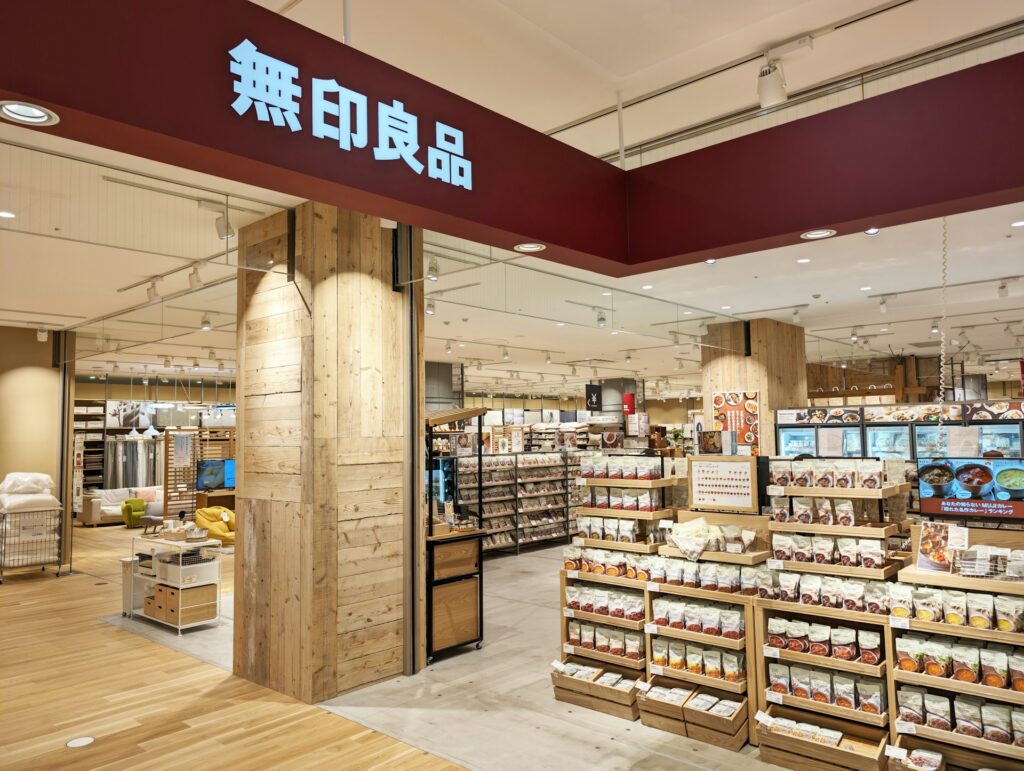
MUJI — short for Mujirushi Ryōhin (無印良品), which roughly translates to “no-brand quality goods” — is one of those brands that’s quietly revolutionary once you understand its ethos.
In the West, there’s a growing conversation around slow fashion and conscious consumption; the idea that we should buy less, buy better, and care about where things come from. MUJI has been doing this since 1980 — not as a marketing angle, but as a founding principle.
Their approach: strip away everything unnecessary. No flashy packaging, no logos, no excess. What’s left is the thing itself — made well, from materials that make sense.
MUJI’s Sustainability Roots (In Plain English)
From day one, MUJI has made choices that, today, we’d call “sustainable” — but back then were simply about not being wasteful. Early products included notebooks made from 70% recycled paper (launched 1981), food sold without decorative boxes, and fabric offcuts from spinning mills repurposed into cleaning cloths. The packaging was plain, the design was minimal, and somehow that became its own kind of aesthetic — something Western shoppers might recognise as a Japanese cousin of Scandinavian design philosophy: functional, honest, beautiful in its restraint.
My MUJI Story (It Started With Stationery)
My first memory of MUJI is from primary school in Japan. Japanese kids bring their own stationery to school — pencil cases, pens, notebooks — and having MUJI supplies was the thing. Their colour pens were smooth, their notebooks felt considered, and there was something quietly cool about the plain packaging in a sea of character-covered everything.
Over the years, MUJI grew with me. Stationery became snacks, then skincare, then homewares, then clothing. Now it’s my first check for almost anything related to daily life.
For a long time, I bought clothes almost exclusively from UNIQLO. But gradually I shifted, especially for items worn close to the skin — innerwear, socks, base layers. Natural fibres genuinely feel different on the body. When I’m wearing MUJI’s cotton or wool pieces, I notice a warmth that’s hard to explain — it’s more settled, somehow. More comfortable at a physical level.
Pricing-wise, MUJI used to feel slightly more expensive than UNIQLO for clothing. But in recent years — partly due to inflation — the gap has narrowed considerably. You can often find MUJI items at comparable or even lower prices, with quality that matches.
What I Bought Last Time
On my most recent trip back to Japan, my MUJI haul included:
- Bra tops (cotton, no underwire — so comfortable I wear them constantly)
- Socks — specifically the Right-Angle Foot-Shaped Socks (直角足なり靴下), which sounds like a very boring product name until you wear them and realise they’re shaped to follow the actual contour of your foot, reinforced at the heel and toe, with a cuff that doesn’t leave a mark
- Organic cotton tights
- Wool and rayon sheer crewneck long-sleeve top
- Fleece jacket — I actually bought the men’s version because I liked the design; it’s incredibly light, warm, and I haven’t had a single shoulder-tense moment wearing it all day
- Double gauze pyjamas — the item I cannot stop talking about
I hadn’t owned proper pyjamas in years. I’d been sleeping in old sweats and a T-shirt, which, honestly, fine. But these double gauze pyjamas changed things. They’re so light you barely feel them, there’s no restriction anywhere, and they’re somehow warmer than they have any right to be for how thin they are. I ordered more when I got back to New Zealand. That’s the level of devotion.
The Packing Table (A Detail I Love)
One small thing that stuck with me from my last MUJI in-store visit: after paying, there’s a packing table with recycling boxes where you can remove and leave any packaging, tags, or stickers you don’t want to bring home. For travellers trying to keep suitcase space to a minimum, this is genuinely thoughtful. And knowing the materials are actually recycled (rather than just tossed) makes it feel good rather than just convenient.
MUJI Café, Too
Worth a mention: MUJI runs cafés in some of their larger stores, serving simple, healthy food at very reasonable prices. When my son was hospitalised during a trip to Japan, the hospital happened to have a MUJI Café inside — and honestly, that little café became a quiet anchor during a really stressful time. If you want to know more about that trip and how Japanese hospitals work, I shared the full story here.
MUJI in a Nutshell
If natural materials matter to you, if you want pieces that are understated rather than trend-driven, and if you’d like your shopping to feel a little more intentional — MUJI will become a habit you don’t regret.
Practical Tips: Shopping UNIQLO & MUJI in Japan
🛍️ UNIQLO Tips
- Check the sale racks first — UNIQLO runs frequent markdowns, and you can find excellent pieces at a fraction of the already-reasonable price
- Try before you buy, especially bottoms — Japanese sizing is typically one size smaller than Western sizing; waists in particular can be quite narrow
- Look for “buzz items” — UNIQLO regularly collaborates with designers and releases limited seasonal items that sell out fast; if something catches your eye, don’t wait
- Consider ordering online for delivery — if your stay is long enough, try on in-store to confirm sizing, then order the exact fit online to your hotel or Airbnb
- GU is next door in many locations — worth a quick visit if you want trend-forward pieces at even lower prices
🌿 MUJI Tips
- Don’t skip the food section — MUJI’s snacks, instant meals, and seasonings make excellent and lightweight souvenirs
- The stationery section is iconic — notebooks, pens, storage items; even if you’re not a stationery person, you might become one
- Look at the natural fabric clothing range — linen, cotton, wool blends; the items are simple but the quality is genuinely there
- Use the packing table — leave any packaging you don’t need at the recycling station before you leave the store
- Download the app — MUJI’s app tracks loyalty points and sometimes offers member-only discounts in-store
General Tips for Both
- Go during weekday mornings if possible — popular stores (especially in Tokyo or Osaka) get very busy on weekends
- Both brands have solid online stores that ship internationally, so you can continue shopping after you return home
- Stock varies by season — if you’re visiting in winter, the heattech and fleece ranges are particularly good; summer brings excellent linen and breathable cottons
Final Thoughts
UNIQLO and MUJI aren’t just shops — they’re a particular kind of Japanese design philosophy made wearable and liveable. UNIQLO says: you can dress well, follow the times, and not spend a fortune doing it. MUJI says: you can own fewer things, made better, and that’s its own kind of luxury.
After ten years of living abroad, both have become less like “stores I visit” and more like reliable friends. The kind where you know what you’re going to get, and you’re always glad you showed up.
If you’ve been to Japan, which one did you end up spending more time (and money) in? Drop your answer in the comments — I have a feeling it’s a personality test in disguise. 😄