
When you think of Kyoto, temples, shrines, and traditional architecture probably come to mind first. And yes, the buildings are stunning, the nature is breathtaking — but for me, the real magic lies in the stone gardens.
As someone with a background in design, I’ve always been drawn to karesansui (dry landscape gardens) in a way that’s hard to fully explain. There’s something about the simplicity, the stillness, the careful arrangement of rocks and raked gravel — they feel both ancient and strikingly modern at the same time. Like a minimalist sculpture you can sit with. A kind of beauty that doesn’t demand anything from you, just offers itself quietly.
I haven’t had the chance to sit in front of these specific gardens just yet, but they’re at the very top of my list for my next trip home. From New Zealand, I research through Japanese landscape journals and Zen art writing to look past the well-worn tourist photos — searching for gardens that showcase the true depth of wabi-sabi and ma, and that offer something genuinely moving to a design-sensitive eye.
Kyoto has countless stone gardens, but these five are my absolute priorities — places where visual harmony and inner stillness come together. If you love art or design, I’d strongly recommend adding at least one to your itinerary. They’re a masterclass in Japanese minimalism that no museum can quite replicate.
5 Must-Visit Zen Gardens in Kyoto
1. Ryoan-ji Temple
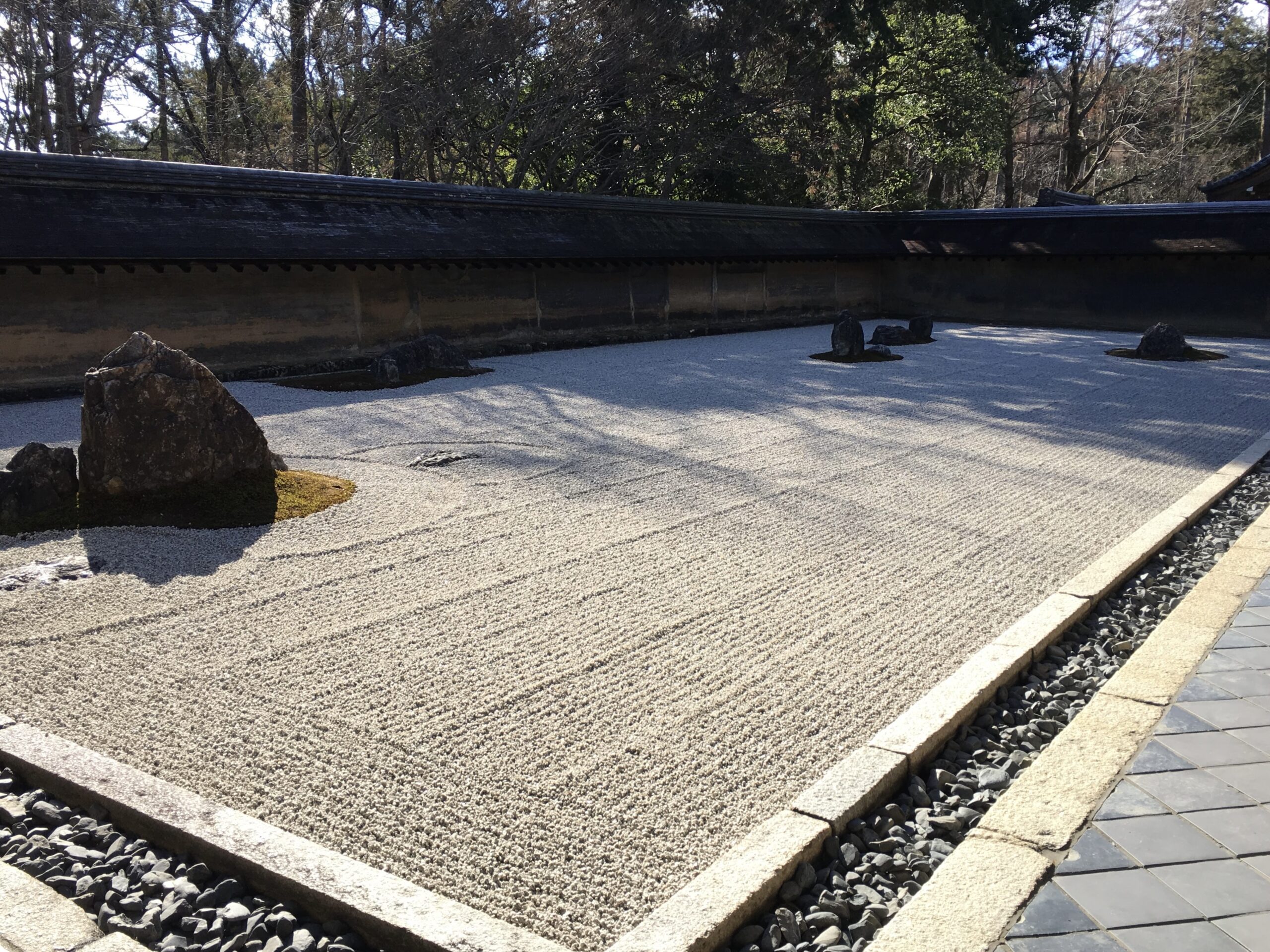
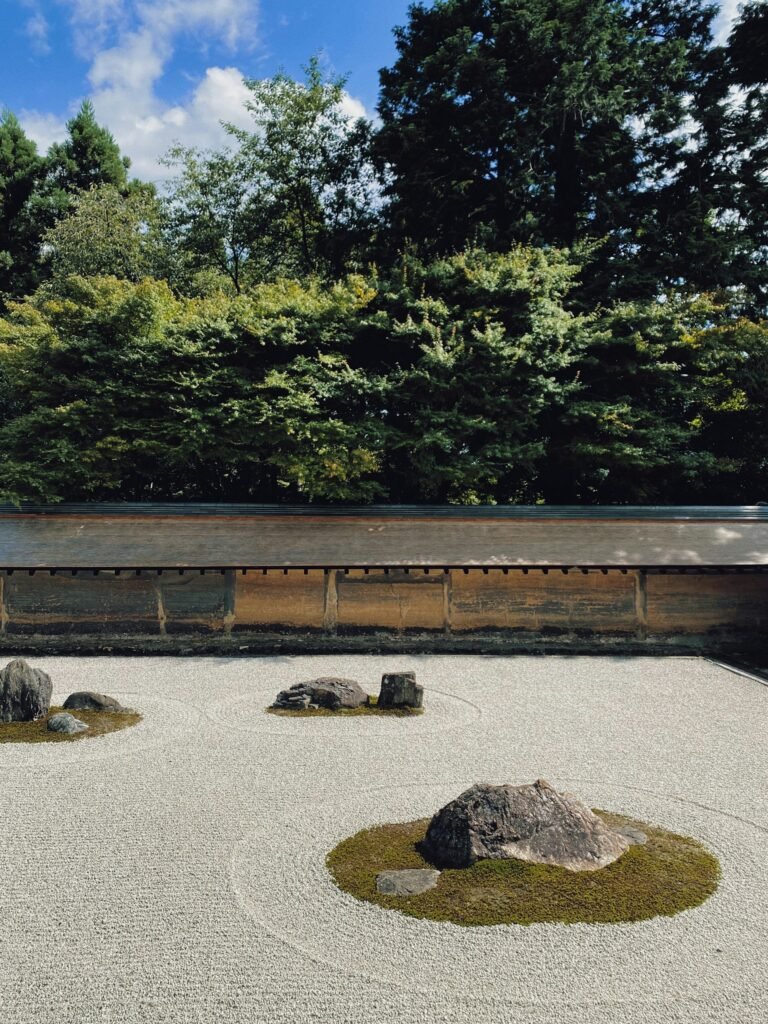
This is probably the most famous stone garden in all of Japan, and for good reason. Ryoan-ji’s karesansui is the ultimate expression of Zen minimalism: 15 rocks arranged in raked white gravel, enclosed by an earthen wall. That’s it. And yet, people sit and stare at it for ages.
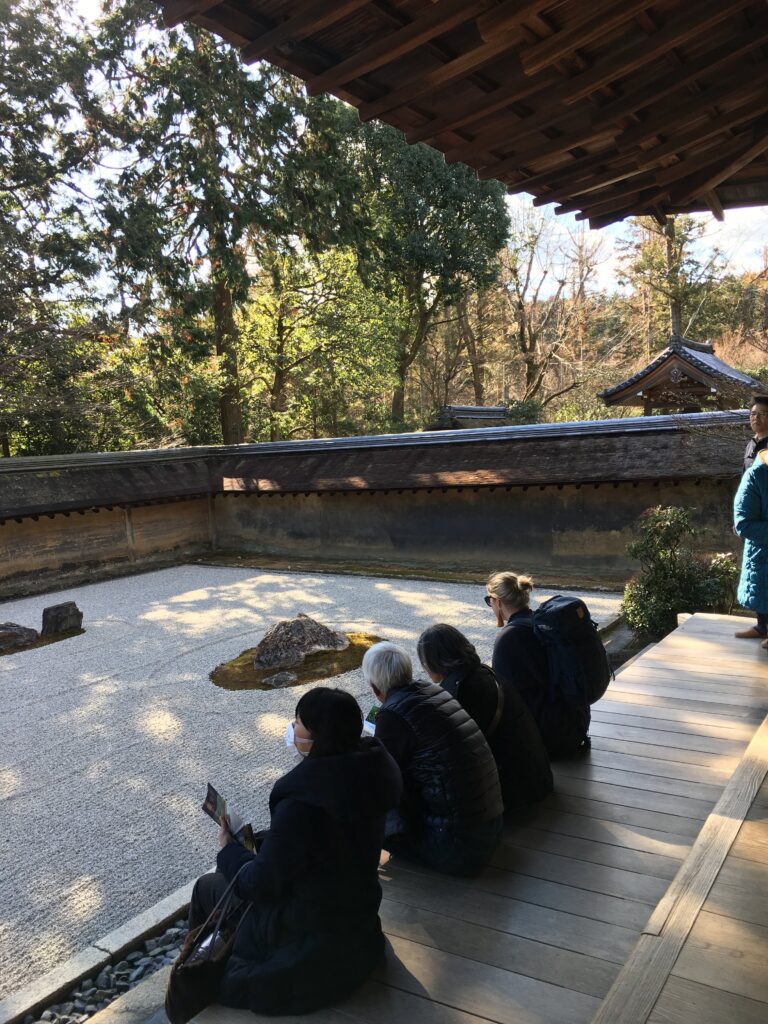
What fascinates me is the mystery behind it – no one knows who designed it or what it’s supposed to represent (some say islands, others say a tiger crossing water, but honestly, it doesn’t matter). The beauty is in the contemplation itself. No matter where you sit on the veranda, you can only see 14 rocks at a time. The 15th is always hidden from view, which feels like such a perfect metaphor for life and perception.
Go early in the morning if you can – before the tour groups arrive – and you’ll have a much more meditative experience.
📍 Address: 13 Ryoanji Goryonoshitacho, Ukyo Ward, Kyoto, 616-8001, Japan
🚇 Nearest Station: Keifuku Railway Ryoanji Station (Approx. 7 min walk) / Kyoto City Bus #59 Ryoanji-mae stop (Immediate access)
🔗 Website
2. Daitoku-ji Temple
Daitoku-ji isn’t just one temple – it’s a sprawling complex of sub-temples, many of which have their own exquisite stone gardens. My personal favourites are Daisen-in and Ryogen-in.
Daisen-in features a stunning kare-sansui that’s designed to represent a landscape painting in three dimensions – mountains, rivers, waterfalls – all expressed through rocks and gravel. It’s incredibly intricate, and the garden “flows” around the building in a way that feels alive despite being completely still.
Ryogen-in, on the other hand, has multiple small gardens, including one called Totekiko – one of the smallest tsubo-niwa (courtyard-style stone gardens) in Japan. It’s just a few rocks in white gravel within a tiny courtyard, but there’s something deeply powerful about its compactness. Sometimes less really is more.
What I love about Daitoku-ji is that it’s quieter than some of Kyoto’s more famous spots. You can take your time wandering between sub-temples, each offering its own unique interpretation of Zen aesthetics.
📍 Address: 53 Murasakino Daitokujicho, Kita Ward, Kyoto, 603-8231, Japan
🚇 Nearest Station: Karasuma Subway Line Kitaoji Station (Approx. 20 min walk) / Kyoto City Bus Daitokuji-mae stop (Immediate access)
🔗 Website

3. Kennin-ji Temple
Kennin-ji is Kyoto’s oldest Zen temple, and while it’s famous for its twin dragons painted on the ceiling of the Dharma Hall, the stone gardens here are equally mesmerising.
The temple features several stunning gardens, including Choon-tei (the Tide Sound Garden), which evokes the rhythmic sound of ocean waves, and the ○△□ Garden (Circle, Triangle, Square Garden) – a strikingly modern karesansui that uses these three fundamental shapes as its core design. These shapes represent the four great elements in Zen Buddhism: earth (square), water (circle), and fire (triangle), expressing the universe’s fundamental forms. The circular patterns raked into the gravel, the geometric simplicity – it all feels surprisingly contemporary, almost like a piece of land art, while still honouring centuries of Zen philosophy and tradition.
I love how these gardens use abstract concepts – shapes, sounds, cosmic elements – and make them visual and tangible.
📍 Address: 584 Komatsucho, Higashiyama Ward, Kyoto, 605-0811, Japan
🚇 Nearest Station: Keihan Main Line Gion-Shijo Station (Approx. 7 min walk) / Hankyu Kyoto Line Kyoto-Kawaramachi Station (Approx. 10 min walk)
🔗 Website | Instagram
4. Tofuku-ji Temple
If you visit Kyoto in autumn, Tofuku-ji is probably already on your list for its legendary maple tree valley. But even outside of fall foliage season, this temple is absolutely worth visiting for its gardens – especially the four gardens surrounding the Abbot’s Quarters (Hojo).
These were designed by the modernist landscape architect Mirei Shigemori in 1939, and they’re a brilliant blend of traditional Zen garden principles with 20th-century design sensibility. The gardens are filled with cosmic and Zen symbolism – some interpret certain stone arrangements as representing the Big Dipper constellation, while the West Garden uses azalea bushes trimmed into geometric squares.
What strikes me most is how bold and graphic these gardens feel – they’re not trying to imitate nature, but rather abstracting it into pure form. It’s Zen minimalism taken in a refreshingly modern direction.
📍 Address: 15-778 Honmachi, Higashiyama Ward, Kyoto, 605-0981, Japan
🚇 Nearest Station: JR Nara Line or Keihan Main Line Tofukuji Station (Approx. 10 min walk)
🔗 Website | Instagram
5. Nanzen-ji Temple
Nanzen-ji is one of Kyoto’s most important Zen temples, and the karesansui in front of the Abbot’s Quarters is a masterpiece of subtlety. It’s not as dramatic as Ryoan-ji or as modern as Tofuku-ji – it’s more understated, which somehow makes it all the more powerful.
The garden is known as “Leaping Tiger Garden” (Tora no Ko Watashi), designed to represent a tiger carrying her cubs across a river. The composition feels balanced yet dynamic, with a sense of narrative woven into the abstract arrangement.
What I also love about Nanzen-ji is the surrounding context – the massive Sanmon gate, the aqueduct running through the grounds, and the peaceful walking paths. After sitting quietly in the stone garden, you can wander through the temple grounds and enjoy the interplay of architecture, nature, and history.
📍 Address: Nanzenji Fukuchicho, Sakyo Ward, Kyoto, 606-8435, Japan
🚇 Nearest Station: Kyoto City Subway Tozai Line Keage Station (Approx. 10 min walk)
🔗 Website | Instagram
Plan Your Zen Garden Walk
To make your exploration easier, I’ve curated a custom Google Map with all the locations featured in this article. You can view them grouped by category, so planning your own seamless Kyoto stone garden itinerary becomes effortless. Just open the map on your phone, and you’ll have every hidden gem at your fingertips.
Whether you’re seeking a moment of stillness in your travels or simply want to experience one of Japan’s most refined art forms, these stone gardens offer something truly special. Take your time, sit on the veranda, let the silence settle in. There’s no right way to experience a Zen garden – just your way.
And who knows? You might find yourself sitting longer than you planned, lost in that beautiful simplicity.